
“Imagine a bird going from branch to branch when you picture these fish moving from pocket to pocket.”
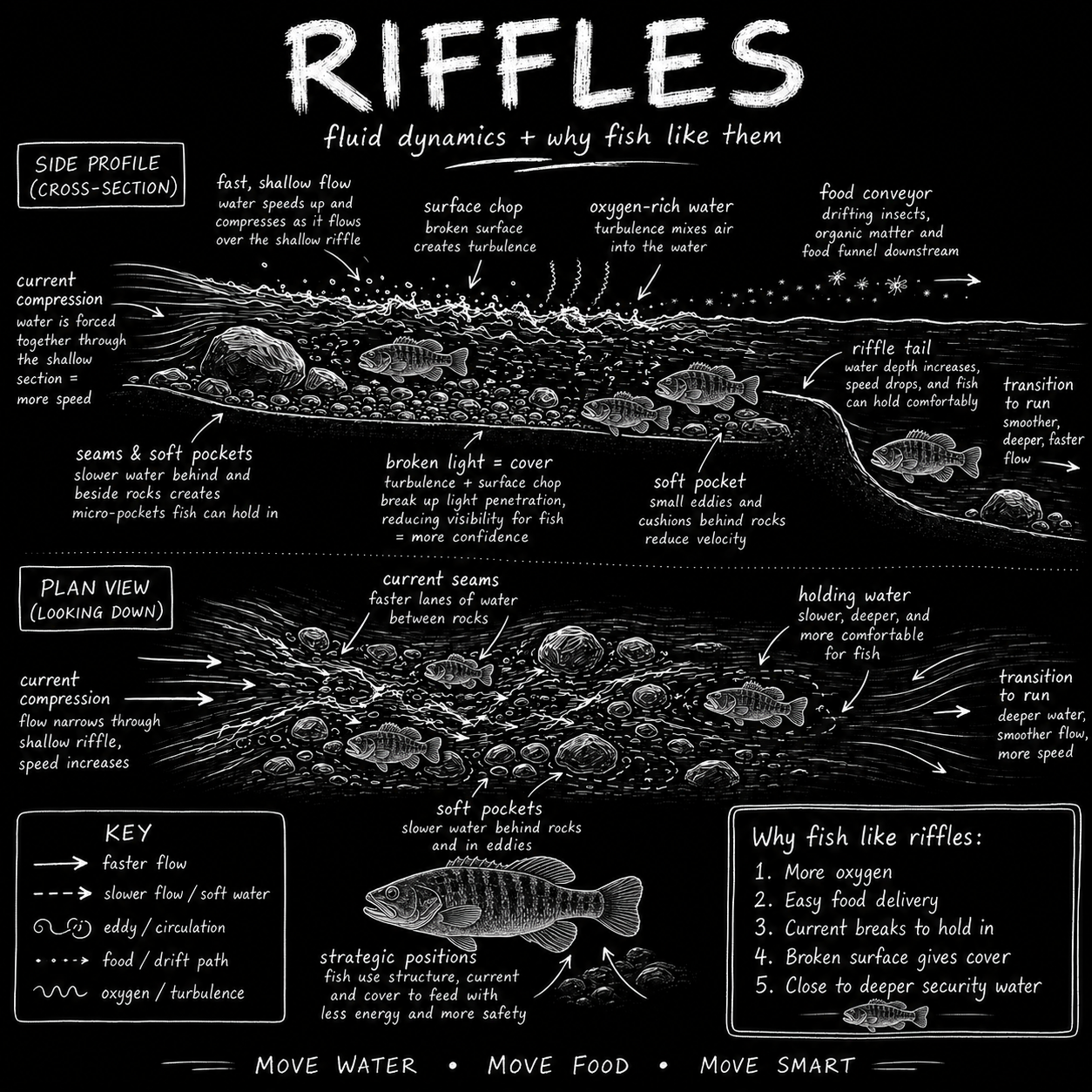
Riffles are those shallow, choppy stretches of creek where the water speeds up and tumbles over gravel, cobble, and scattered rocks. They may not look like much compared to a deep hole or a big undercut bank, but I’ve learned not to walk past them too quickly. A good riffle is doing a lot more than making noise. It is moving water, stirring things up, carrying food, and creating a bunch of little places where a fish can sit without fighting the full force of the current.
As water gets pushed through a shallow section of creek, it generally speeds up. Rocks break that current apart, sending water around them, over them, and sometimes back behind them in little swirling eddies. That means a riffle isn’t really one big sheet of fast water. It is a collection of fast lanes, slow lanes, seams, pockets, cushions, and tiny current breaks. To us it may look like chaos. To a fish, it looks more like a neighborhood full of good places to sit.
All that broken water also helps mix air into the creek and promotes oxygen exchange at the surface. That can make riffles especially attractive during warm weather, when dissolved oxygen becomes more important. The chopped-up surface has another benefit too: it makes fish harder to see from above. Sunlight gets scattered, the bottom becomes harder to make out, and predators—including fishermen—have a tougher time getting a clean look at what is down there. That little bit of visual cover can make a shallow riffle much more comfortable than its depth would suggest.
Then there is the food. Current is basically a conveyor belt, and riffles are one of the places where that conveyor gets busy. Aquatic insects live among the rocks, crayfish tuck into the gaps, and anything that gets knocked loose is immediately carried downstream. Smallmouth bass can hold just outside the strongest current and let the creek bring dinner to them. Instead of swimming around burning energy looking for food, they can sit behind a rock or along a seam and wait for something edible to come past.
When I fish a riffle, I usually pay more attention to the broken pieces of water than the riffle as a whole. A rock sticking out of the current may create a soft pocket directly behind it. Two rocks may funnel water between them and form a faster feeding lane. A slight depression in the creek bottom can give a bass just enough depth to disappear. The edge where fast water rubs against slower water is especially worth a cast. Those seams let a fish sit in comfortable water while keeping its nose right beside the food coming down the chute.
The tail of the riffle is another place I rarely ignore. As the creek begins to deepen again, the current usually settles down and the broken water transitions into a run or pool. That gives fish the best of both worlds: food washing out of the riffle and deeper water close by if they need to retreat. A smallmouth may slide up into the riffle to feed and then drop back toward the deeper tail when it wants an easier place to hold. If I only had time to make a few casts, the transition from the riffle into deeper water would be high on the list.
The biggest mistake with riffles is assuming shallow water means empty water. Sometimes it does. Other times there is a bass sitting behind a rock in water barely deep enough to cover its back. Slow down, look for the little changes in current, and remember that fish are always trying to balance three things: food, safety, and the amount of energy it takes to stay put. A good riffle gives them all three. Once you start seeing those little soft spots hidden inside the fast water, riffles stop looking like something you wade through and start looking like something you fish.
