
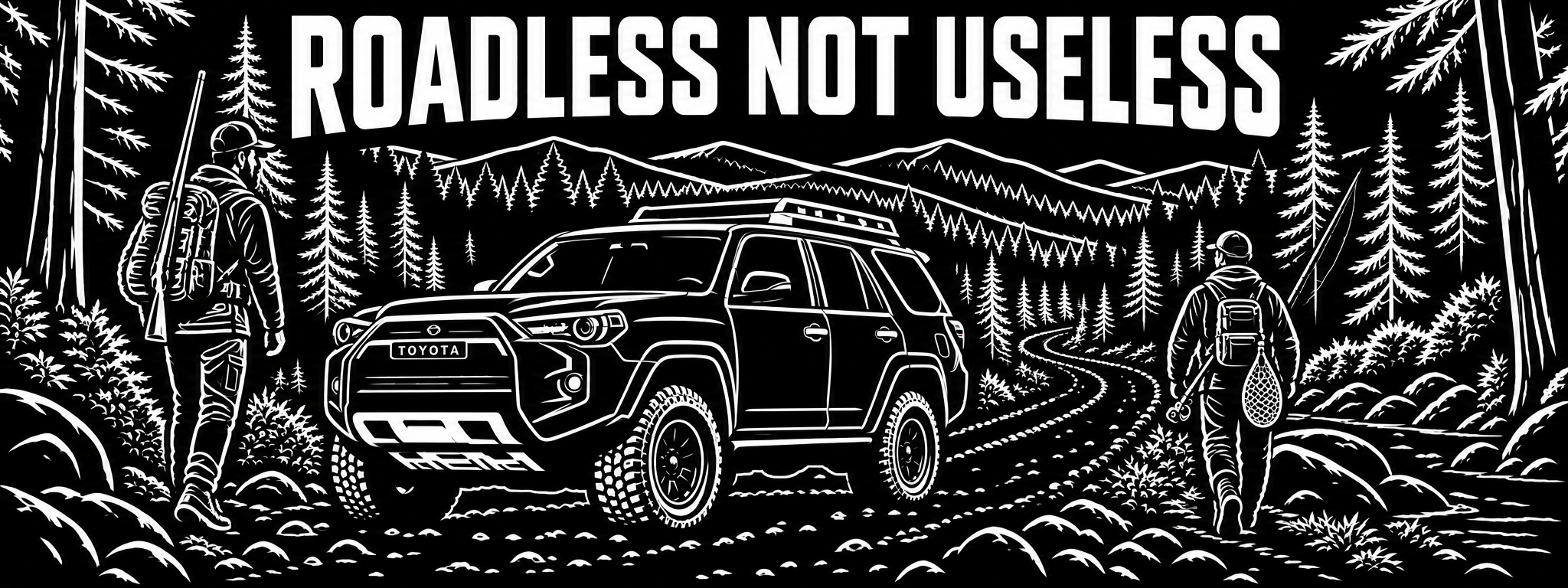
A Road Into the WILDERNESS Is MORE THAN a Road
One thing the woods will teach you is that land can look empty to somebody who doesn’t know it. A wooded ridge on a map just shows as green space. To somebody who spends time there, it’s the head of a trout or smallmouth stream, a place where deer and elk cross in November, an ancient stand of old-growth timber, or wilderness where you can still walk for hours without hearing anything mechanical.
The current argument over the Roadless Rule caught my attention and I’ve been digging into it.
The rule dates to 2001 and generally restricts new road construction, road reconstruction and timber harvesting in inventoried roadless areas of the National Forest System, with exceptions. It does not give these lands the wilderness designation and ban motorized vehicles, nor does it prohibit hunting, fishing, hiking or other traditional uses. Existing roads may remain, and motorized recreation continues where it is legally designated.
The current administration is proposing to rescind the nationwide rule and return more of those decisions to individual national forests and their management plans. Supporters argue that this would give local managers more flexibility for wildfire prevention, timber management, access and forest health. That argument deserves consideration. A policy written in D.C. cannot account perfectly for every ridge, watershed and community in the country.
But local control does not automatically mean local restraint, and there is significant risk of exploitation. A road changes more than transportation. It creates access.
New People on Old Roads
There is another group worth considering in this debate outside of hunters and anglers: the rapidly growing overlanding and off-road recreation community.
Driving an old Forest Service road into the mountains and camping beside your truck used to simply be called ‘camping’. Today it has become a full-fledged outdoor subculture, complete with specialized vehicles, rooftop tents, navigation apps, recovery equipment, YouTube channels and entire industries built around reaching remote places.
I understand the appeal. I offroad and also hunt and fish. I do both on public land. An old rutted road disappearing into a holler scratches the same itch as a trout creek disappearing around a bend. You want to know where it goes and you want to be the only one there.
Most responsible overlanders are not trying to bulldoze new trails through unspoiled woods. They are using existing roads and trails legally designated for motorized travel and are there to appreciate nature.
The argument over the Roadless Rule begins where the existing road ends.
If an abandoned logging road is rebuilt, an administrative road becomes permanent, or a new road is pushed farther into roadless country, that does more than help timber or forest management. It creates access. To an overlander, that may sound like opportunity. To a hunter who values walk-in country or an angler trying to protect a remote headwater stream, it may sound very different. (To a land developer, it is music to their ears.)
Roads bring traffic, noise and easier human access into places that previously required effort to reach. They can also alter drainage and become sources of erosion, sediment and pollution. There is nothing inherently wrong with a dirt road. Hunters use them. Anglers use them. Older or disabled outdoorsmen may depend on them. They provide access for firefighting, rescue and forest management.
The question is not whether roads are good or bad. The question is how many roads a place can absorb before its character changes.
The irony is that an overlander and a backcountry hunter are chasing the same thing: a place that still feels far away. One wants to reach it with a 4x4 truck. The other wants to park the truck and walk beyond it. Somewhere between those two desires, a line has to be drawn, but there is much overlap in the interests of all.
THE Creek NEXT TO the Road
That line becomes more important when we start talking about water.
In Appalachia, a river does not begin as a river. It begins as a spring, a seep, a wet hollow or a little seasonal creek you can step across. Enough of those come together and eventually somebody downstream calls it a river. A lot of them have roads next to them.
Kentucky changed the way it regulates some of those waters in 2025 with Senate Bill 89. For years, state law broadly defined the “waters of the Commonwealth” to include rivers, streams, creeks, lakes, ponds, springs, wells, marshes and other surface and underground waters and charged their care to the state. The new law ties much of Kentucky’s pollution-control jurisdiction more closely to the federal definition of protected waters.
Supporters say the previous system allowed state regulators to reach too far and created unnecessary permitting burdens for landowners, farmers and businesses. That is a legitimate concern. Environmental regulation should be clear enough that ordinary people can understand what they are allowed to do on their own property.
The concern on the other side is that the federal definition of protected water has itself been narrowed and remains politically unsettled. Kentucky’s own Energy and Environment Cabinet has warned that depending on how the federal definition develops, a large percentage of the state’s stream miles could fall outside the primary water-pollution framework. Other laws and protections would still apply, so it would be inaccurate to say those streams suddenly become completely unprotected. But the change is significant, particularly in a state filled with small headwaters, springs, karst systems and intermittent streams.
This is not technically part of the Roadless Rule debate. Neither is the recent fight over selling federal public land. They are different laws dealing with different things.
But on the ground, the issues meet.
Build a road across a mountainside and you change how people reach the land. Cut the slope and you change how water moves across it. Change the law governing the small creek below and you may change what happens when that water is damaged.
Those are separate laws. They are not separate mountains.
We Have Seen This Before
Appalachia has already lived through what happens when distant interests discover something valuable beneath a mountain or standing on top of it. Timber companies bought enormous tracts and timber rights, sometimes from people who had little experience with deeds, mineral rights or the true market value of what they were selling. Coal brought wages and built towns, but it also produced company communities where employers could control housing, stores and much of daily life. When miners tried to organize, Appalachian labor history sometimes turned openly violent—from forced evictions and armed mine guards to the bloody conflicts remembered as the Mine Wars.
Those industries fed families, and that should never be erased from the story. But neither should what happened when the boom ended. Companies consolidated, mechanized, closed mines or moved on. Workers and their families were left to absorb the consequences in communities built around an industry they did not control. Even today, Central Appalachian coal counties continue to wrestle with population loss, poverty and the economic effects of declining coal employment.
The land was left with consequences too. By the early twentieth century, industrial logging had stripped huge areas of the southern mountains. Erosion, fires and flooding helped drive passage of the Weeks Act and the creation of eastern national forests. Some of the land that became places like Daniel Boone, Pisgah and Nantahala National Forests was purchased from timber and coal companies after much of its commercial value had already been removed. The Forest Service then spent decades restoring forests and watersheds on land private industry had often left cut over and depleted.
There is an uncomfortable history on the conservation side too. The creation of public land did not always happen neatly or painlessly. Most eastern national-forest acquisition was through purchase, often from willing owners or corporations, but there were condemnations and there were mountain families who lost their farms or were evicted. Forest Service histories of eastern Kentucky acknowledge federal purchases of mountain farms followed in some cases by the eviction of former owners and tenants.
And the broader Appalachian conservation movement produced harsher examples. At Shenandoah National Park—technically a national park rather than a national forest—hundreds of mountain families were forced from land assembled for the park during the 1930s. Some residents were physically evicted. Their houses were sometimes dismantled or burned after they left.
That history ought to make anyone skeptical of simple stories from either direction. Americans have been told before that somebody from outside needed their timber, their coal or their land for the greater good. Sometimes the promise was prosperity. Sometimes it was conservation. Either way, local people did not always get to decide what happened next.
Which makes the present moment hard to ignore.
Much of this country has spent the better part of a century healing. Forest has grown back over old cuts. Streams once buried in silt run clear again. Wildlife has returned to places that had been worked nearly bare. The public paid to restore and maintain much of that land after earlier generations watched its wealth leave by truck and rail.
Now there is renewed pressure to make some of that recovered country easier to reach, easier to drive, easier to log and potentially easier to develop.
That does not mean every timber sale is the beginning of another century of exploitation, or that every new forest road leads to a coal camp. Forests need management. Rural communities need economic opportunity. People deserve access to the public land they own. It’s public for a reason.
But history gives us a fair reason to be cautious.
Once a road is cut through a forest, the question changes from should there be a road to what should we allow on this road. That second question is much harder.
Repealing the Roadless Rule would not sell public land. Changing Kentucky water law does not authorize a logging road. None of these policy changes should automatically be treated as pieces of one coordinated plan.
But neither should we ignore how they interact. Roads make timber, minerals and recreation easier to reach. They can make future development easier to consider. They also create drainage, culverts and erosion, and the water coming off that road eventually becomes somebody’s creek.
Maintain the roads we need. Keep legitimate public access open. Give overlanders thousands of miles of existing roads to explore. Manage forests where management is needed. Protect the little streams coming off those mountains, whether somebody has bothered to give them a name or not.
And before we push another road into country that has managed to remain without one, we ought to be certain we really need it.
Because here in the wilderness, roadless does not mean useless.
Sometimes it simply means there is still a place (and needs to be a place) beyond the end of the road.
