

There’s something humbling about watching an osprey catch a fish. You can spend half the morning changing lures and convincing yourself the bite is off. Then a bird drops out of the sky and carries lunch away. It’s also cool realizing they’re out here fishing just like me.
Look for long, angled wings, a pale underside, and a dark stripe at the eye. In flight, that bend at the wrist gives an osprey a different outline from the broad, flat silhouette of an eagle. It's the size of an eagle but smoother and with more varied coloration. Very agile in the air. Around lakes, rivers, and coastlines, you can hear its sharp, whistling calls before you spot it.
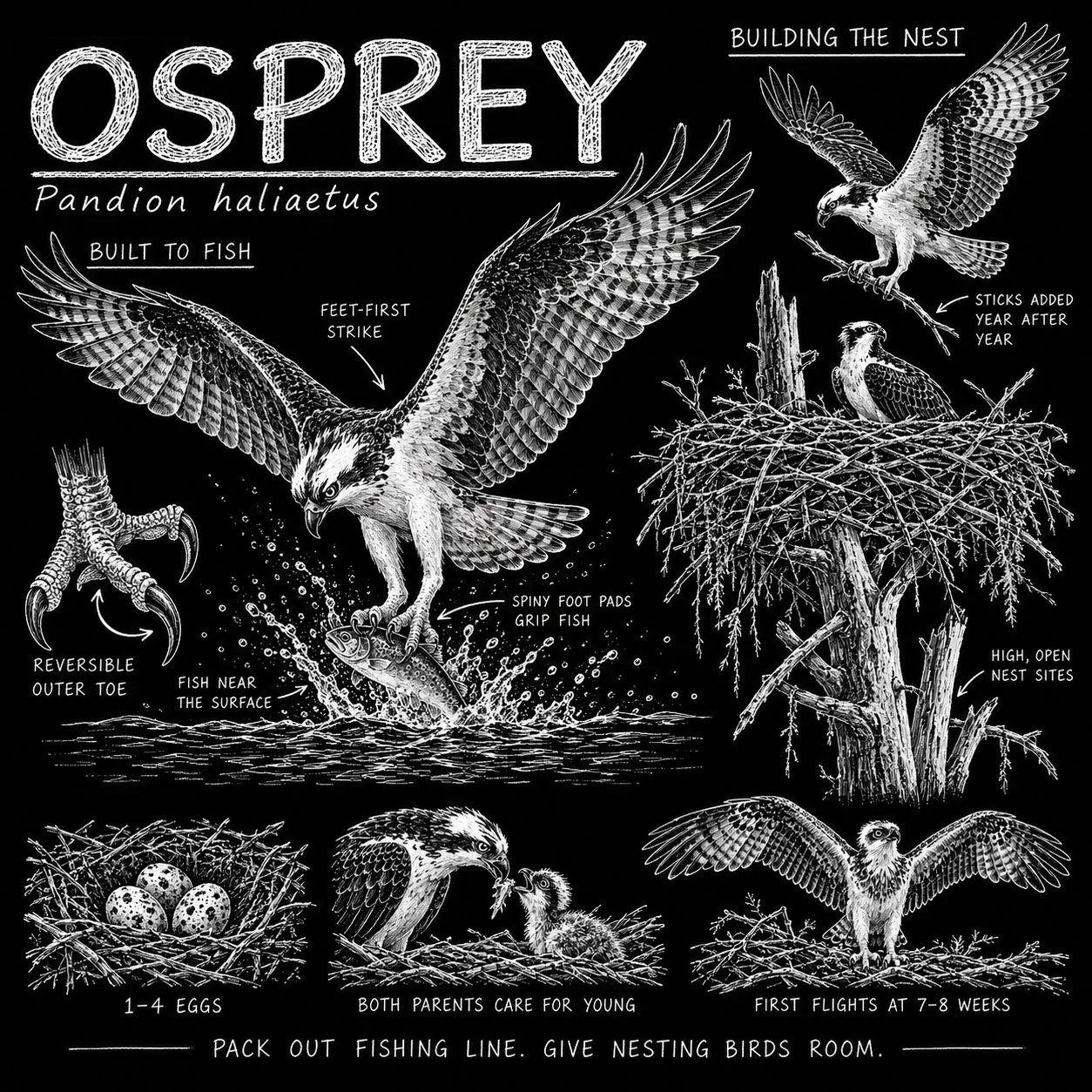
An osprey hunts by watching the water from above, sometimes hovering before committing to a dive. When a fish comes within reach, the bird drops feet first, driving its talons into the water. It may go under in the process, then beat its way back into the air with its catch. It's loud too. Has startled me many times as they strike the water behind me.
For an osprey, fishing is a living. Nearly its entire diet is fish, and everything from its feet to its nesting season is built around getting them. Their feet are adapted to fishing. An osprey can rotate its outer toe backward, giving it two toes on each side of a fish. Spiny pads help hold the slippery catch. Once airborne, it usually turns the fish headfirst into the wind, making the load easier to carry. I've seen them land in a treetop and begin shredding the fish as they call out proudly.
Its reach has limits, they don't dive under the water. Ospreys generally take fish near the surface, so a deep pool is useful only when fish move high enough to grab. Considering the creeks that I fish, it makes sense I see so many osprey. If there’s one working a stretch of water, that tells me there are fish there. It doesn’t tell me which lure to throw, but it gives me a good reason to go check it out. Typically it's carp. They make good targets as they just hold in the current.
Ospreys return to their breeding grounds in spring and use the same nest every year. They fly all the way to Central or South America for winter, with young birds making that first trip on their own. I always enjoy seeing them and feel like they’ve really made a comeback recently. I see them nearly every time I'm out fishing. I’m not to the point of naming them yet, but I could see it happening. They all look very much the same to me though.
