

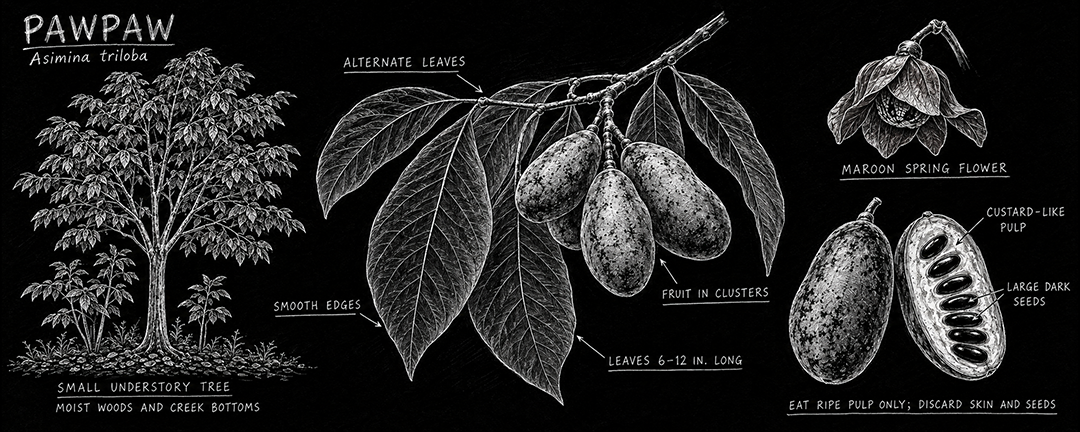
The pawpaw looks like an escapee from the tropics and is sometimes called the Appalachian banana. Native to eastern North America, this small tree grows in moist woods, sheltered slopes, and creek bottoms. Trees have a slender trunk like a sapling and grow broad, drooping leaves that make it stand out beneath the taller hardwoods. Once you learn the shape, you’ll start noticing patches along the same wooded banks you walk while fishing if you’re lucky. You can also smell the ripe fruit on the breeze when they are in season.
Look for big leaves arranged in a row with one biggest leaf at the tip of the branch. Leaves are usually six to twelve inches long, broadest toward the outer end, with pointed tips and smooth edges without teeth. In spring, dangling maroon flowers that smell like rotting meat attract flies and beetles that carry pollen between trees. Pawpaws also send up shoots from their roots, so a whole patch of slender trunks may actually belong to the same plant.
The fruit hangs singly or in clusters, looking something like a small green potato. Inside is a soft, goopy flesh surrounding several large, dark seeds all in row. The taste is somewhere between rotten banana and Sweet-Tarts. It isn’t the best flavor ever and can be off-putting from its pungency. Pawpaws ripen from August to October, depending on the location and tree. A ripe one gives slightly under gentle pressure, smells sweet, and releases with a gentle tug. Color alone won’t tell you much as a ripe pawpaw will still be green.
Once you’ve positively identified a pawpaw, split a ripe fruit and scoop out the pulp, discarding the skin and seeds. It’s good fresh, and the pulp can be frozen for later use in ice cream or other recipes. Handle the fruit gently because it bruises easily and lasts only a few days at room temperature. Leave some for the woods, too. Raccoons, opossums, and other wildlife eat the fruit, while zebra swallowtail caterpillars depend on pawpaw leaves. A reminder that even a skinny little tree can be an important part of the ecosystem.
NOTE: The pawpaw plant and its fruit contain an acetogenin that can cause palsy-like reactions from repeated, long-term exposure. I treat pawpaw as an occasional seasonal food rather than a daily staple. I don’t eat the skins or make anything with the seeds.
